





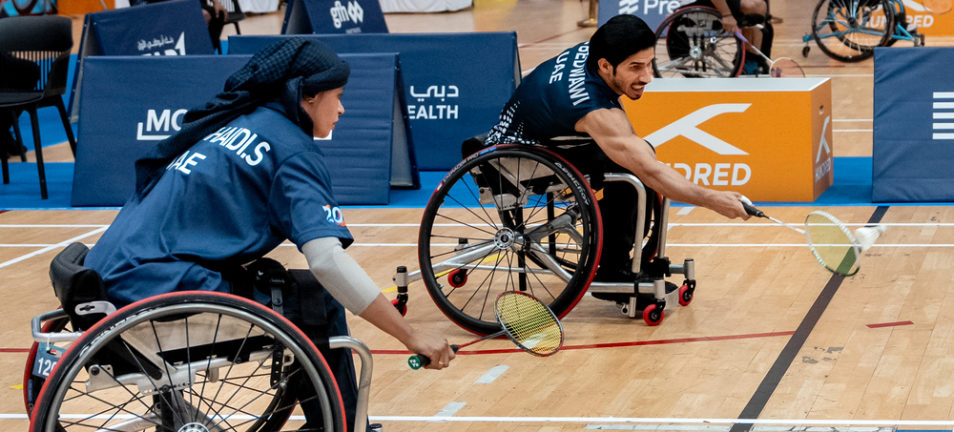
Best Practice – UAE Badminton Federation

Promoting Inclusion Through Badminton: A Best Practice from the UAE Badminton Federation
Sub Areas:
- Inclusion & Integration
- Special Olympics
- Workforce Development
- Promotional Activities & Campaigns
Overview
The “Promoting Inclusion Through Badminton” initiative led by the UAE Badminton Federation in partnership with Special Olympics UAE represents a scalable and sustainable model for inclusive sports development. Implemented between January 2020 and December 2021, the programme sought to address the limited participation opportunities available to athletes with intellectual and developmental disabilities in badminton.
The project built upon the legacy of major sporting events such as the Special Olympics MENA Regional Games (2018) and the Special Olympics World Games Abu Dhabi (2019), using the momentum generated to establish a nationwide ecosystem for inclusive badminton.
For organisations seeking to replicate this model, the initiative demonstrates how a national federation can create structured pathways, foster partnerships, and embed inclusion into mainstream sport delivery systems.
Approach
Before implementation, several interconnected challenges were identified in establishing inclusive badminton programmes in the United Arab Emirates. Athletes with intellectual and developmental disabilities had limited structured access to training opportunities, and there were no clear grassroots-to-competition pathways to support long-term progression. Although the 2018 and 2019 Special Olympics events raised awareness, sustaining engagement beyond these one-off initiatives required a more systematic and legacy-driven approach. Additionally, gaps in coach and staff expertise limited programme quality, while the COVID-19 pandemic disrupted in-person participation and demanded rapid adaptation. Overall, effective inclusion needed to address multiple structural and cultural barriers rather than relying solely on event-based participation.
Actions Taken
1. Strategic Partnerships and Governance
The initiative was anchored in a formal collaboration between the national federation and Special Olympics, strengthened by partnerships with international bodies, government councils, universities, and sport organisations. This multi-stakeholder framework ensured:
- Resource sharing
- Technical expertise
- Policy alignment
- Nationwide programmes reach
A formal Memorandum of Understanding (MOU) solidified long-term commitment and accountability.
2. Capacity Building Through Structured Training
A major focus was on developing human capital to sustain inclusive delivery. Actions included:
- “Train the Trainers” webinars
- Training 2,118 coaches, PE teachers, and support staff
- Qualification of approximately 50 specialised coaches
- Training of around 60 umpires for inclusive competitions
This ensured high-quality delivery and standardisation across the country.
3. Nationwide Club and Competition Structure
Another focus was to provide continuous engagement for clubs and improve its competition structure such as:
- 12 Special Olympics badminton clubs were launched across all seven Emirates
- Regular competitions (6–8 annually) were organised
- Unified badminton events promoted inclusion and social interaction
This structure created a consistent pathway from participation to competition.
4. Athlete Engagement and Programme Continuity
During the COVID-19 pandemic, the project adapted swiftly by introducing virtual training and engagement sessions to maintain continuity. Between 2021 and 2022, more than 600 participants from around the world took part in these online activities. This flexible approach enabled the initiative to sustain athlete involvement and engagement despite the limitations imposed by global restrictions.
5. Visibility and Advocacy Through High-Profile Events
Events at major platforms such as Expo 2020 Dubai significantly elevated awareness and showcased inclusive sport to broader audiences.
Key Results
12
Special Olympics badminton clubs established nationwide
350
athletes benefited over five years
2k+
coaches and support staff trained; 50 coaches formally qualified to strengthen inclusive badminton delivery
6-8
competitions organised annually, creating consistent competitive pathways for skill and social inclusion
600
participants worldwide during programme adaptation during the pandemic
Secured a formal partnership between UAE Badminton and Special Olympics UAE for long-term alignment and impact
Enabled athlete progression to global stages, including the Special Olympics World Games Berlin 2023
Demonstrated a scalable, resilient, athlete-centred model for inclusive sports development
Why This Is a Best Practice Model
This initiative is considered a best practice because it integrates inclusion into the national sports ecosystem rather than relying on one-off events. It demonstrates strong multi-stakeholder collaboration across government, education, international federations, and community organisations, ensuring shared ownership and efficient use of resources. Clear athlete pathways; from grassroots participation through clubs and competitions to elite international levels. Capacity building is central, with large-scale training enabling long-term scalability and local ownership. The programme’s adaptability, including a successful shift to virtual delivery during the pandemic, highlights its resilience. Finally, long-term sustainability is ensured by embedding badminton within Special Olympics structures and education systems, allowing continued growth beyond the project lifecycle.
Key replicable elements:
- Embed inclusion within existing national sports systems, not standalone events
- Build partnerships across government, education, and community sectors
- Establish structured pathways from grassroots to elite competition
- Prioritise large-scale stakeholder training for sustainability
- Design flexible delivery models to adapt to disruptions
- Integrate programmes into existing institutions to ensure long-term continuity
Key Takeaways for Replication
Organisations seeking to replicate this inclusive badminton model should consider the following ideas:
- establishing formal partnerships with disability sport organisations and relevant government bodies to secure alignment, resources, and credibility.
- Capacity building should be prioritised by training coaches, teachers, and volunteers before expanding athlete programmes, ensuring quality and inclusive delivery.
- A clear participation framework is essential, incorporating grassroots club networks, regular competitions, and progression pathways to higher-level events.
- Rather than creating separate systems, inclusion should be embedded within existing school, community club, and national federation structures. Programme visibility can be strengthened by showcasing inclusive events within major national competitions to build awareness and stakeholder support.
- Organisations should design for long-term sustainability by integrating adaptable delivery modes (including hybrid or virtual engagement), alongside ongoing monitoring, evaluation, and stakeholder feedback mechanisms.
Conclusion
The UAE “Promoting Inclusion Through Badminton” initiative demonstrates how a national federation can transform inclusive participation from a niche activity into a structured, sustainable national programme. Through strategic partnerships, extensive capacity building, structured athlete pathways, and adaptive delivery mechanisms, the initiative created long-lasting impact for athletes with intellectual and developmental disabilities.
For organisations seeking to replicate this practice, the key lesson is clear: inclusive sport development must be systemic, collaborative, and sustainable. By embedding inclusion into governance, training, competition structures, and education systems, federations can create enduring opportunities for athletes of all abilities to participate, develop, and excel in badminton.
This model provides a proven roadmap for scaling inclusive sport programmes globally while strengthening both participation and social impact within national sport ecosystems.